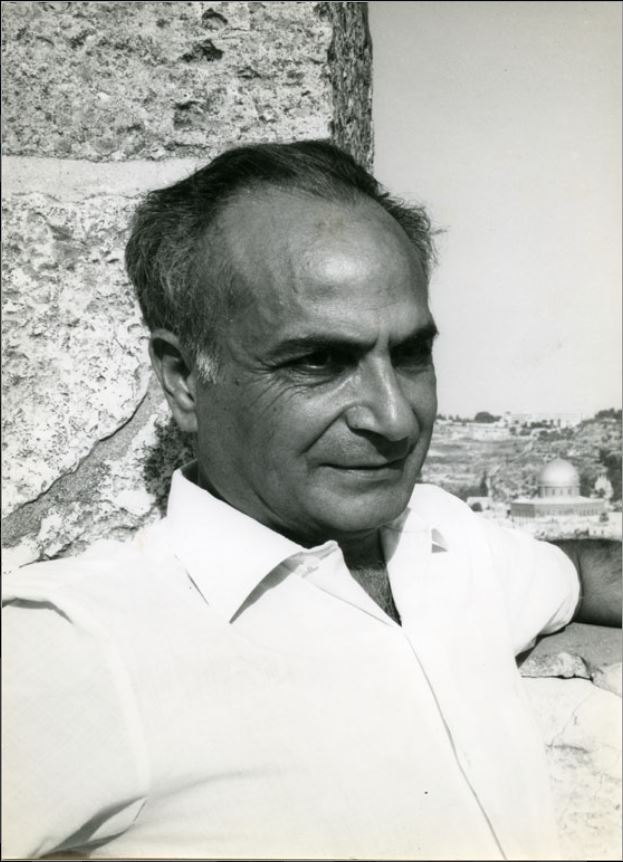
Jerusalem, on the roof of the Citadel of David, 1967
Nathan André Chouraqui was born in Aïn Témouchent, Algeria, on August 11, 1917. His parents, Isaac Chouraqui and Meleha Meyer, both descended from Spanish Jewish families that included, from the 16th century onward, judges, theologians, rabbis, poets, and scholars devoted to the development of North African Judaism.
His law studies brought him to Paris in 1935, where he also began rabbinical studies. During the war, he actively participated in the French Resistance in the maquis of central France (1942–1945). A lawyer, then judge in the jurisdiction of the Court of Appeal in Algiers (1945–1947), he was awarded a Doctorate in Public International Law from the University of Paris in 1948.
Deputy Secretary General of the Alliance Israélite Universelle (1947–1953), André Chouraqui became its Permanent Delegate under the presidency of René Cassin (1947–1982). He traveled the world giving lectures in more than 80 countries. From Jerusalem, where he settled in 1958, he remained the spokesperson for French culture in Israel and became an ambassador for Israel and for peace throughout the world.
Vice-President of the Commission of Non-Governmental Organizations at UNICEF-UNAC (1950–1956), he proposed and secured the adoption of the trachoma eradication program — a project that saved the sight of millions of children worldwide.
Director of the Sinaï Collection (Presses Universitaires de France), A. Chouraqui published in French foundational texts of Jewish culture, such as works by Luzzato, Buber, Kaufmann, Halkin, and Maimonides.
In 1958, he married Annette Lévy, daughter of Doctor and Mrs. Gaston Lévy. They had five children: Emmanuel, Elisabeth, Yaël, David, and Mikhal, 14 grandchildren, and 13 great-grandchildren.
Settled in Jerusalem from 1958, he became the adviser to the Prime Minister, David Ben-Gurion (1959–1963), on matters of integration of Jews from Muslim countries and intercommunal relations.
From the moment he settled in Israel, he was the inspiration behind and founder of interfaith cooperation committees bringing together representatives of Jewish, Christian, and Muslim authorities. These committees were an innovation that built a bridge in Israel and worldwide between religions and confessions separated by centuries of conflict. A. Chouraqui was the co-founder and president of the Interfaith Committee in Israel and internationally, having previously co-founded the Amitié Judéo-Chrétienne and the Fraternité d'Abraham in France, and served on the council of the World Conference on Religions and Peace (W.C.R.P.).
In the framework of the Nostra Aetate declaration, André Chouraqui met Cardinal Daniélou. From this meeting arose a movement uniting followers of the Abrahamic religions, the Fraternité d'Abraham, in collaboration with the Rector of the Paris Mosque, Hamza Boubakeur, and Father Riquet.
In 1965, André Chouraqui was elected Deputy Mayor of Jerusalem under the mandate of Teddy Kollek. He was in charge of cultural affairs, interfaith and international relations of the city of Jerusalem. From 1969 to 1973, he was re-elected city councillor and president of the Commission for Culture and External Affairs of Jerusalem.
He served as a member of the tribunal of the World Zionist Organization, founding president of the Alliance Française in Jerusalem, president of the Interfaith Committee in Jerusalem, president of the Israel Film Institute (Reginald Ford Foundation), and president of the Movement for a Near Eastern Confederation.
As a member of the Executive Committee of the World Congress of Religions for Peace, André Chouraqui took an active part in interfaith movements and advocated for the development of friendship among Jews, Christians, and Muslims.
He published some forty books, wrote hundreds of articles in the international press, and gave numerous lectures on the political and spiritual issues raised by the rebirth of the State of Israel. Universal in its essence, his body of work spans diverse fields — poetry and theater, philosophy and fiction, history and sociology, law — and most notably the translation and exegesis of the Old and New Testaments and the Qur'an.
His name is also written: André Chouraqui · Andre Chouraqui · Nathan André Chouraqui · Nathan Andre Chouraqui · A. Chouraqui · Chouraki · אנדרה שוראקי · נתן אנדרה שוראקי · أندريه شوراقي